
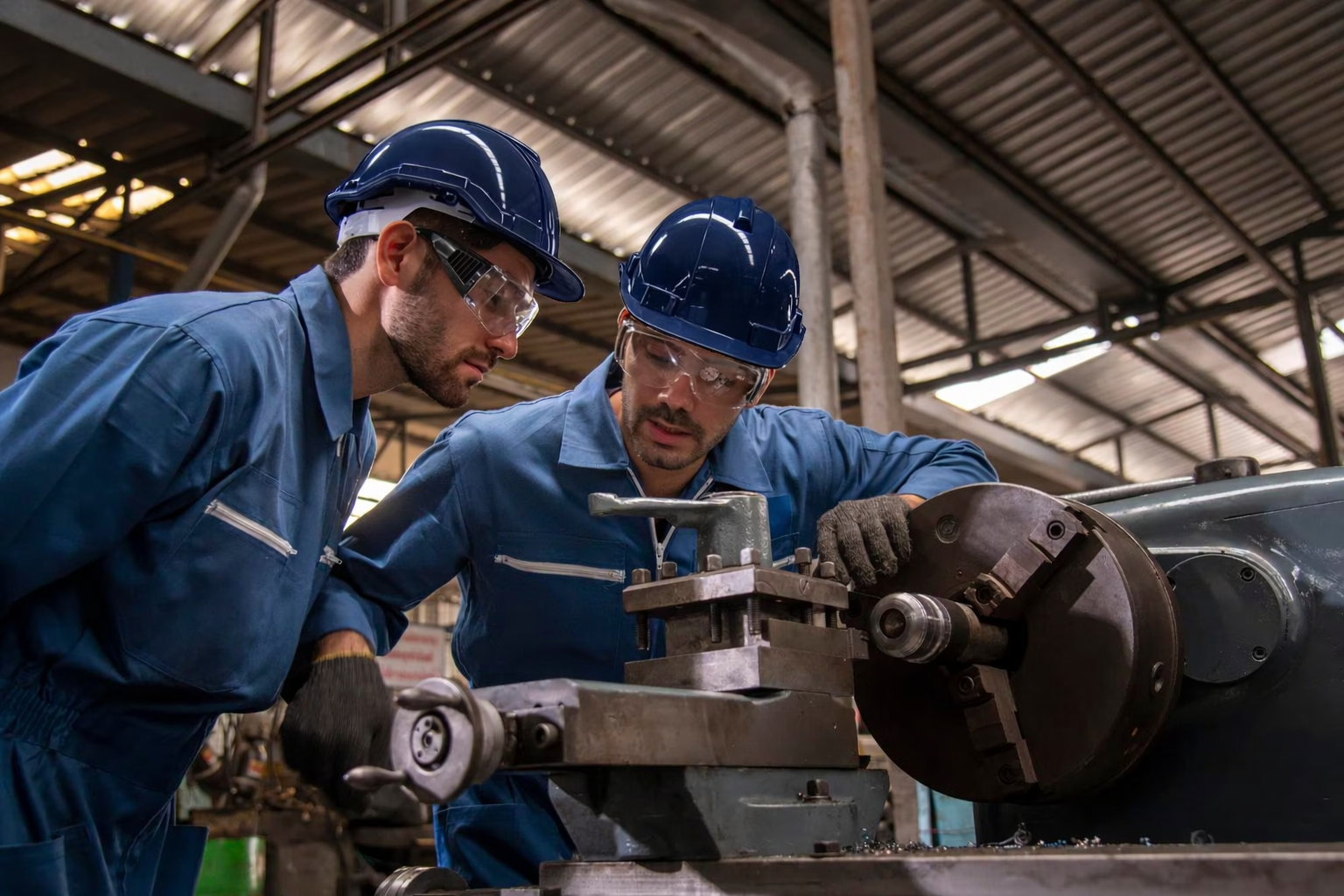
Your new millwright arrives with a Red Seal certification and eight years of industrial experience. On paper, qualified. In practice, three weeks in they’re still shadowing your lead millwright, asking where tools are kept, how to log work orders in the CMMS, and which vendor handles the hydraulic pump failures on line 3.
Six weeks in, they can run routine PM tasks unsupervised, but they’re calling for backup on facility-specific troubleshooting. Your lead millwright is spending half their time answering questions instead of maintaining equipment. Twelve weeks in, the new hire finally operates independently.
That’s 12 weeks of reduced productivity and your most experienced worker functioning as an unpaid trainer. The cost: $27,200 per new millwright in lost productivity and trainer time. For a facility that hires four millwrights annually, that’s $108,800 in onboarding costs alone.
Most facilities accept this as normal. High-performance facilities have built knowledge transfer systems that cut ramp-up time to 3-4 weeks, reduce training burden on existing staff by 60%, and decrease first-year turnover among new hires by 35%. This isn’t about creating binders full of SOPs that no one reads. It’s about structured systems that transfer facility-specific knowledge quickly, without burning out your experienced crew.
Research from Canadian Manufacturers & Exporters found that 68% of manufacturing employers identified “time required to train new workers” as a top barrier to hiring. The average skilled tradesperson requires 8-12 weeks to reach 80% productivity in a new facility, even when they arrive with years of industry experience.
The problem isn’t technical competence. Your new millwright knows how to align a coupling, read hydraulic schematics, and troubleshoot motor failures. What they don’t know:
That facility-specific knowledge isn’t written down. It lives in Dave’s head. When you hire someone new, Dave becomes an unpaid trainer while still being expected to maintain equipment. The new hire learns inconsistently, depending on how busy Dave is. When Dave retires or leaves, that knowledge walks out the door.
Canadian construction and skilled trades turnover data shows 22% of skilled trades hires leave within 12 months – often because chaotic onboarding left them feeling unsupported. Facilities with structured knowledge transfer systems cut ramp-up time by 60-70% and reduce first-year turnover by 35%.
A knowledge transfer system is not a training program. It’s a structured process for capturing facility-specific operational knowledge from experienced workers and transferring it to new hires in a documented, repeatable, measurable way.
Traditional onboarding: “Follow Dave around for a few weeks and ask questions.”
This approach has three failures:
A knowledge transfer system formalizes:
High-performance facilities build five components: facility-specific knowledge inventory, structured learning path with 30-60-90 day milestones, documentation that people actually use (visual guides, checklists, videos), designated training accountability, and competency validation checkpoints.
The time to capture facility-specific knowledge is not the day before your lead millwright retires. It’s now, while that knowledge is still accessible.
How high-performance facilities capture knowledge:
Schedule 90-minute sessions with experienced millwrights, one system at a time. Use a facilitator to ask structured questions: “Walk me through diagnosing a jam on the #2 conveyor.” “What are the three most common failure modes on the packaging line hydraulic system?” “When you get called overnight for an unplanned shutdown, what’s your diagnostic sequence?” Record these sessions, have them transcribed, turn the transcripts into procedures, visual guides, or decision trees.
Create equipment-specific one-pagers that include:
These one-pagers live in the CMMS, on the shop floor, and in new hire packets. They’re working documents, not archives.
Build a video library for complex procedures. For tasks difficult to describe in text—aligning a coupling, troubleshooting a PLC fault, replacing a hydraulic seal under pressure—record a 3-5 minute video of an experienced millwright performing the procedure while narrating. Videos don’t replace hands-on training, but they allow new hires to review procedures multiple times without interrupting experienced workers.
The ROI: A facility that invests 20 hours of senior millwright time at $65/hr = $1,300 to document a critical system creates a reusable training asset that reduces onboarding time for every future hire by 4-6 hours, saving $208-$312 per new hire. If that facility hires three millwrights over five years, the documentation pays for itself after the second hire.
New hires need to know: “What am I expected to master by when?” Without clear milestones, onboarding drags on for months because no one knows when “trained” actually means trained.
High-performance facilities define specific competencies a new hire must demonstrate at 30, 60, and 90 days. This creates accountability for both the new hire and the organization.
Competencies to demonstrate by day 30:
Training activities: Facility tour, safety orientation, CMMS walkthrough, shadowing PM routes, assisted execution of lubrication and filter changes.
Validation: New hire completes a supervised PM route and troubleshooting scenario while trainer observes and signs off using a competency checklist.
Competencies to demonstrate by day 60:
Training activities: Independent PM execution with spot-checks, assisted troubleshooting on 3-5 real callouts, leading minor repairs under supervision.
Validation: New hire handles three troubleshooting calls independently with post-call review and CMMS documentation audit.
Competencies to demonstrate by day 90:
Training activities: Independent operation with weekly check-ins, cross-training on specialized systems (hydraulics, pneumatics, controls), shadowing lead millwright on complex repairs.
Validation: 90-day performance review with competency sign-off, new hire handles on-call duty with experienced millwright as backup.
Research published in Scientific Reports found that workers who received structured onboarding with clear competency milestones had 35% lower turnover in their first year compared to those who received informal “follow and learn” onboarding. Clarity reduces anxiety. New hires who know what’s expected and can see their progress are more confident, more engaged, and less likely to leave.
The biggest obstacle to effective knowledge transfer: facilities expect experienced millwrights to train new hires “on the side” while maintaining full productivity on their own work. This doesn’t work. Training takes time, focus, and energy. When you ask someone to do both jobs simultaneously, both suffer.
High-performance facilities treat training as a distinct job function:
Designate one experienced millwright as the primary trainer for each new hire’s first 60 days. This person is accountable for executing the onboarding roadmap and validating competencies. If a millwright is spending 50% of their time training during weeks 1-4, their PM workload gets reduced by 50%. Backfill that work with overtime, temporary coverage, or redistribution to the rest of the team.
Facilities that compensate trainers with a $2-5/hour premium during active training periods signal that training is valued work, not an unpaid favour.
The cost-benefit: A facility that pays a $3/hour premium for 120 hours of training (weeks 1-6) spends $360. That same facility saves $8,840 in unstructured trainer time and $11,000+ in lost productivity by cutting ramp-up from 12 weeks to 4 weeks. Net savings: $19,480 per new hire.
One reason knowledge transfer fails: facilities try to onboard new permanent hires while operating short-staffed. The existing crew is already covering the vacancy, working overtime, falling behind on PM work. Adding “train the new person” to that overloaded list doesn’t work.
How temporary coverage supports effective onboarding:
A facility hires a new permanent millwright and brings in a temporary millwright for 4-6 weeks to handle routine PM work and provide surge capacity. The permanent new hire focuses on learning without the pressure of “we need you productive today.” The existing crew trains properly without burning out. The temporary worker maintains productivity.
The ROI on temporary coverage:
Facilities that view onboarding as “we hired someone, now we’re fully staffed” end up with poorly trained workers, burned-out trainers, and high first-year turnover. Facilities that use temporary coverage to create space for proper knowledge transfer see measurably better outcomes.
Most facilities don’t track onboarding effectiveness. They hire someone, hope it works out, notice a problem only when the new hire quits or makes a costly mistake. High-performance facilities track four metrics and use that data to improve continuously.
How many days until a new hire executes routine PM tasks without supervision?
Track this for every new hire. If time-to-independence increases, investigate: inadequate documentation, insufficient training time, poor hiring fit, or gaps in the roadmap.
How many hours of experienced millwright time are consumed training each new hire?
If trainer time remains high despite documentation, improve the usability of training materials or revisit the roadmap.
Conduct brief check-ins at 30, 60, and 90 days. Ask:
Track trends across multiple hires. If confidence scores are consistently low at 60 days, your system has gaps.
What percentage of new hires stay beyond 12 months?
Poor onboarding drives early turnover. New hires who feel unsupported or frustrated by chaotic onboarding leave within 6-12 months.
How continuous improvement works in practice: A facility tracks metrics and discovers new hires consistently struggle with CMMS navigation and vendor contacts during weeks 3-5. The facility creates a 15-minute CMMS video tutorial and a vendor contact quick-reference guide. Next quarter’s new hires report higher confidence scores at 60 days, and time-to-independence drops by one week. The facility documents the improvement and continues iterating.
Knowledge transfer is an investment that pays for itself in months and compounds value for years. The question isn’t whether to build the system. It’s how to build it without falling behind on the work that’s already overdue.
Your experienced millwrights can’t document procedures, train new hires, and maintain equipment at the same time. Trying to do all three simultaneously is how training programs stall, documentation never gets finished, and your best people burn out before the system is in place.
Temporary staffing bridges that gap. A facility that brings in experienced temporary millwrights to handle day-to-day PM work and callouts frees its permanent crew to focus on capturing knowledge, building documentation, and training new hires properly. Instead of choosing between keeping the line running and building a better onboarding system, you do both.
Once your knowledge transfer system is operational, your facility runs leaner, onboards faster, and retains longer. The goal is a self-sustaining system. Temporary coverage is how you get there without sacrificing productivity or burning out the people whose knowledge you’re trying to capture.
Regional Staffing Solutions delivers pre-trained, safety-certified millwrights in 24-48 hours with transparent, no-placement-fee pricing across Alberta, BC, and Ontario. Whether you need temporary coverage to protect an onboarding period, backfill while your team builds training infrastructure, or maintain operations during the transition to a structured knowledge transfer system, contact us to discuss your staffing needs.


